I went climbing last night. It was the first time in about 5 months I had grabbed any rock. For my partner it had been about 6 months. We knew we were in for some disappointment. Rock climbing is a sport that requires pretty specific muscle development. You don't get better at climbing by jogging or lifting weights. The only way to stay in shape is to climb things with your fingers. Still, we talked with a little bit of optimism since we had at one time been fair-average climbers.
For my first climb I chose a route rated near the top of my all-time high skill level (5.10 for you climbers). I figured my best chance was to hit it while I was fresh. I made it maybe 15 feet before falling. My arms quickly told me what I didn't want to believe. I wasn't going to be climbing at my old level that night. My partner gave it a go too with all the optimism that comes from watching someone else fail. When you are watching someone else climb you always feel like you could have done better. Then when you get on the wall everything looks different.
I quickly downgraded myself and tried an easier route. Was it just me or were they making routes harder than they used to? I didn't do much better, and since I had nearly exhausted my arms on my first attempts I was worried I wouldn't be able to complete a single climb. Finally, we made our way over to a climb that was rated just high enough not to be embarrassing for grown men(5.7). I climbed as fast as I could before my grip strength ran out and just barely made it without resting. What a relief! We climbed with frequent long breaks for about an hour and a half. In the past we had climbed continuously without breaks for two hours. It was hard not to feel disappointed. There was no logical reason for us to have expected a better outcome, but I guess there's a pride we all have that overestimates our abilities. Just before packing up to leave I went over to the stretching/workout area and grabbed some gripper balls for doing pull-ups on. I found that I was still able to do multiple pull-ups. The problem hadn't been shoulder or upper arm strength. My failure to climb was completely due to a weak grip.
Here comes the spiritual twist.
In the Christian life we can get strong at a lot of things. We can become theological weight lifters that can expound on Biblical precepts. We can memorize the words to all the latest worship songs. We can become ninjas at encouraging others. We can master every Gospel presentation available. We can attend every event faithfully.
But if we lose our grip on Jesus, none of that strength matters. If we neglect the reality of the cross, if we habitually let our focus drift from our identity in Christ, if we don't push ourselves to keep walking in the Spirit, we will loose our grip. You may not be able to escape his grace, but you certainly can slip into spiritual lethargy that is not easy to bounce out of. Just because you had a vibrant, consistent faith years ago doesn't mean you can automatically get back to it once you're "less busy." A firm grip on Jesus is developed over months and years of spiritual discipline. Doing the daily chores of talking and listening to Jesus, loving your neighbor and humbling yourself is not our means of pleasing God. It is our method of consuming and being consumed by him.
You can't become even an average rock climber over night. You can build muscle strength quickly, but your tendons and joints have to develop over a longer period of time. That comes with practice. It is the same way with knowing and loving God. It takes practice and patience. And the payoff is amazing.
Wednesday, January 28, 2015

Wednesday, October 15, 2014
Don't Worship Facebook
 See that little red circle around the black clock on my browser toolbar? That is a Chrome extension called Stay Focused. I have a list of sites that do not pertain to my work and are especially tempting time wasters. Stay Focused allows me to visit these sites for a predetermined time period. When time is up it blocks access to all the sites on my list. I've found it a great tool to help me manage my online time wisely.
My list of limited sites includes Facebook, Instructables, YouTube, and others.
But something happened the other morning that "got me ta thinkin'" about my use of Facebook. I woke up, and without much thought, reached over to my cell phone and opened my Facebook app. It was the first thing I wanted to do in the morning! I put my cell phone back down and admonished myself for being so shallow and felt really guilty for some reason. Still the desire to pick my phone back up and just scroll through a few updates was nagging me. What's wrong with me?
 |
| StayFocused keeps me from squandering internet time |
I didn't know at the moment why I felt my desire was bad, why it should be labeled a "temptation" and not just a regular event in life. After some meditation on the subject I realized my danger. You see, the feeling I had toward Facebook was a feeling I had had before toward something else. I realized the desire I had to get up and discover what was happening on Facebook matched a similar desire I have had at times in my life to get up and discover what I could learn from time in the word of God.
That "at times in m life" phrase may bother you because I am a pastor. Perhaps you believe as a pastor I should at all times be excited about reading my Bible. I confess I am not. Let me tell you why. Seeking God is an exceptional exercise. It is like mountain climbing. There is great reward, but there it requires great struggle. There are moments of ease and comfort, and there are moments that require great sacrifice and endurance. No one should be deceived into thinking that worshipping God is an easy or comfortable activity. But I can testify that it is worth it. The reward is incomparable. So, yes, I can only say that I am sometimes really excited about "getting into God's word" as we Evangelicals like to say. Other days I still make the effort. I still discipline myself to try because in the trying I am building up the endurance and patience and spiritual strength and wisdom it will take to be ready for the next thing the God has for me to experience. I have learned that it is worth it.
Now Facebook (or Pintrest or Twitter or ESPN or whatever .com it is that entices you) comes along and offers a much less rewarding yet more consistent experience of fulfillment. We have built into us a hunger to experience truth. That hunger is only rightfully fulfilled by God, but the internet offers the feeling of truth fulfillment. Social media gives us the feeling of connectedness not only to people but to a vast wealth of knowledge. Where God seems to be stingy with his revelations, the internet will leave no curiosity denied. Our smart phones represent an (apparently) endless repository of knowledge, the ability to know what all our friends are doing, instructions about how to be feeling about the world, and the chance to speak our thoughts in a way that we know will be heard and might possibly get instant feedback. All in a package we can carry around in our pockets.
When we pray to God we often get silence and waiting. When we pray to Facebook (status update) we get likes, shares and comments. When we read the Bible we often have to study diligently and endure puzzling difficulties. When we peruse our feed we don't have to spend time thinking about anything. We don't even need to read long articles; we can just watch the video and be told how to think and feel. When we allow God to speak to us we are often challenged to change out thinking or behavior. When we listen to social media we are reaffirmed in our bias, fears and comforts because we have a self-perpetuating system of likes.
I know it is all silliness. I don't really think Facebook sustains me emotionally or spiritually or intellectually. It just feels like it does. So like a drug gives your body the feeling of health and pleasure for a moment, Facebook can make my spirit feel sustained. Like candy makes your mouth happy, social media can give you an emotional sugar rush of affirmation. But drugs and candy will not sustain a healthy human!
So if we really want to experience God--that is, if we really want to have a meaningful interaction with our creator in such a way that we are aware that He is real and He is active in our life. If you want to have that experience like I do, then we are going to have to squelch the competition. We are going to have to mute the things in our life that pretend to offer the same things that God does. It is not as easy as blocking tempting sites (though that may be a useful thing to do). There will always be new temptations, new false idols, new ways to be drawn away from a healthy hunger for God's kingdom. I do not want to allow "drugs and candy" to dull my spiritual hunger. I want to be fully alert even if it means temporary suffering, self-denial and waiting.
Lord, watch over my heart and help me not to worship Facebook.
Tuesday, October 14, 2014
Suffering for future generations
Same-sex marriage is being allowed based on the idea that marriage is a matter of individual conscience, and as such individuals who practice homosexuality should have the same rights to enter in to marriage as those who do not practice homosexuality.
What is being ignored in this debate is the question of what is the government's role in marriage? Why is marriage an issue of public policy at all? If marriage is simply a matter of individual conscience (i.e. people should be able to marry who they want to) then what basis does the government have for limiting any type of marriage? If we are going to assume individual conscience is the guiding principle for who should be able to get married, then we must soon start repealing laws against polygamy, marrying family members, marrying animals, corporate marriages, marrying fictional characters and the list goes on. To be honest, I don't know if there are laws against all of those things, but I can imagine that human creativity and perversity will force those issues sooner or later.
If, you say, the government's interest is to protect people from inappropriate sexual relationships, I would point out that our society has almost completely removed sexual relations as an legal interest in marriage. Marriage is not legally required for anyone to have sex in any way imaginable. Marriage partners are not legally bound to respect the sexual norms associated with the tradition of marriage (i.e. marital faithfulness). There are laws against sexual acts that are seen as a violation of those who do not consent (or are deemed unable to consent with understanding). But even these laws are applied unevenly and without a well thought out ethical consideration. In society's mind some things are still "just wrong." I highly doubt that many people could give an ethical argument for why unwed consensual teenage sex is legal but child pornography is not, yet it seems the majority opinion is that one is okay (or even necessary) while the other is an abomination that requires the shame of going on a permanent, public database with a mugshot and address for the perpetrator. If children cannot responsibly give consent it should not matter who they are giving the consent to. Just because other children are doing the abusing it doesn't make the abuse any less.
Returning to my point, if we are going to have any marriage laws at all we need to have a basis for doing so. The debates have been about rights and equality, but few have addressed the real question underlying these laws--the relationship of the government, the individual and the community.
If those were the terms of the debate then we could talk with reason.
As a Christian I believe that homosexual activity is a sin. I see it as a perversion of the gift of sex that God gave us for the purpose of pleasure and procreation. I do not deny that some individuals may struggle more than others with a temptation toward homosexuality even to the point of feeling "born this way." It is clearly observable that many (most?) struggle with a temptation toward adultery and pornography and all sorts of other sexual perversion, but the presence of those temptations do not make them "natural" in the sense of being acceptable before God. While it may seem cruel for me to ask others to deny themselves the pleasures they feel they were born to posses, we must recognize that we do this all the time. The entire justice system is built on the idea that we must persuade people to restrain themselves from doing what they might feel they were born or compelled to do. I see homosexual activity as a sin that is an affront to God and damaging to those who participate. Because of this belief I would encourage people to find a way to avoid or flee that lifestyle, but I also recognize that it is not currently illegal (in most places). So I can speak in one way about my moral beliefs as a Christian, but what should I say as an American Citizen?
First, my moral beliefs are relevant when it comes to discussions of public policy. Even without evoking the Bible or my personal religious practices, I have a right to speak and promote what I feel is right and wrong for others to do. Liberty is the word we use for freedom in America, but to imagine that all individuals are free to do as they want is logically impossible. Liberty in America must mean a willingness to accept responsibility as a citizen of the People. Ultimately, it is the freedom of the People that is protected by the constitution, not merely the freedoms of the individual. I know that is a radical interpretation that has lots of implications for other debates, but that's how I see it. It is on this point, I believe, that democracy is most vulnerable. There is no final standard for values. The people must decide to agree, or else democracy fails. There is no king to go to to resolve disputes. There is no American Standard Moral Code. We have to agree, compromise, or fight ourselves into oblivion.
Second, as an American I have an interest in a public policy that brings stability to our society. The cold hard scientific evidence shows that traditional families are good for our society. Traditional families promote less crime, higher education rates, higher employment rates, better health, more stable markets. I believe that same-sex marriage is a change to marriage law that will benefit neither traditional marriage couple or same-sex couples. The results will be higher family instability, confusing and damaging legal situations, emotionally scarred children, an increase in divorce, and a decrease in the marriage rate. See AN ECONOMIC ASSESSMENT OF SAME-SEX
MARRIAGE LAWS by DOUGLAS W. ALLEN from Harvard Journal of Law & Public Policy [Vol. 29].
In spite of my ethical and philosophical approach to the idea of marriage I know that most peoples' opinion boils down to a simple statement we hear all the time. "If two people love each other, who am I to tell them not to get married?"
This simple statement is hard to argue against persuasively because it appeals to our American ideal of "live and let live" and an echo of romanticism that still drives pop culture (even though "love" itself has little real meaning beyond a commercial drive for fulfillment. Love, for the masses, is a tool that corporations use to sell their products). We want to agree with the statement, yet a critical eye can see the problem right away. We are not debating love. We are debating legal marriage. There have never been laws dictating whom you can love. Those would be unenforceable. We are not even debating laws about sex, adoption, benefits, photographers, cakes, etc. We are talking about marriage. If two people love each other great for them. When it comes to marriage, the law has it's own requirements and none of them are love. As far as the government is concerned marriage is an institution that simplifies a common situation of a man and woman wanting to unite a household, to support each other economically, and most importantly potentially raise children in a safe and stable environment. Alternate definitions of marriage threaten the intended public policy purpose of marriage. All the laws that currently apply to marriage will be complicated as they must be applied to situations they were not designed for. Future laws concerning marriage will be difficult to craft as they will need to account for all the different circumstances that will (eventually) be considered a legal marriage. The impact on future generations will not be worth the feeling of liberty experienced by a few.
My heart goes out to all of those affected by this non-debate. I don't doubt most people's sincerity. I can see that many people feel that they are standing up for what is right. I understand that there are real injustices going on against people who practice homosexuality. I don't deny that the pain is real or that rejection hurts. I'm sorry for that. Honestly, I see ways we could mitigate that pain somewhat in our society, but I don't think this shift in our thinking about marriage will result in less pain for the people of our society. On the contrary, I am convinced that because of this more people will suffer.
What is being ignored in this debate is the question of what is the government's role in marriage? Why is marriage an issue of public policy at all? If marriage is simply a matter of individual conscience (i.e. people should be able to marry who they want to) then what basis does the government have for limiting any type of marriage? If we are going to assume individual conscience is the guiding principle for who should be able to get married, then we must soon start repealing laws against polygamy, marrying family members, marrying animals, corporate marriages, marrying fictional characters and the list goes on. To be honest, I don't know if there are laws against all of those things, but I can imagine that human creativity and perversity will force those issues sooner or later.
If, you say, the government's interest is to protect people from inappropriate sexual relationships, I would point out that our society has almost completely removed sexual relations as an legal interest in marriage. Marriage is not legally required for anyone to have sex in any way imaginable. Marriage partners are not legally bound to respect the sexual norms associated with the tradition of marriage (i.e. marital faithfulness). There are laws against sexual acts that are seen as a violation of those who do not consent (or are deemed unable to consent with understanding). But even these laws are applied unevenly and without a well thought out ethical consideration. In society's mind some things are still "just wrong." I highly doubt that many people could give an ethical argument for why unwed consensual teenage sex is legal but child pornography is not, yet it seems the majority opinion is that one is okay (or even necessary) while the other is an abomination that requires the shame of going on a permanent, public database with a mugshot and address for the perpetrator. If children cannot responsibly give consent it should not matter who they are giving the consent to. Just because other children are doing the abusing it doesn't make the abuse any less.
Returning to my point, if we are going to have any marriage laws at all we need to have a basis for doing so. The debates have been about rights and equality, but few have addressed the real question underlying these laws--the relationship of the government, the individual and the community.
If those were the terms of the debate then we could talk with reason.
As a Christian I believe that homosexual activity is a sin. I see it as a perversion of the gift of sex that God gave us for the purpose of pleasure and procreation. I do not deny that some individuals may struggle more than others with a temptation toward homosexuality even to the point of feeling "born this way." It is clearly observable that many (most?) struggle with a temptation toward adultery and pornography and all sorts of other sexual perversion, but the presence of those temptations do not make them "natural" in the sense of being acceptable before God. While it may seem cruel for me to ask others to deny themselves the pleasures they feel they were born to posses, we must recognize that we do this all the time. The entire justice system is built on the idea that we must persuade people to restrain themselves from doing what they might feel they were born or compelled to do. I see homosexual activity as a sin that is an affront to God and damaging to those who participate. Because of this belief I would encourage people to find a way to avoid or flee that lifestyle, but I also recognize that it is not currently illegal (in most places). So I can speak in one way about my moral beliefs as a Christian, but what should I say as an American Citizen?
First, my moral beliefs are relevant when it comes to discussions of public policy. Even without evoking the Bible or my personal religious practices, I have a right to speak and promote what I feel is right and wrong for others to do. Liberty is the word we use for freedom in America, but to imagine that all individuals are free to do as they want is logically impossible. Liberty in America must mean a willingness to accept responsibility as a citizen of the People. Ultimately, it is the freedom of the People that is protected by the constitution, not merely the freedoms of the individual. I know that is a radical interpretation that has lots of implications for other debates, but that's how I see it. It is on this point, I believe, that democracy is most vulnerable. There is no final standard for values. The people must decide to agree, or else democracy fails. There is no king to go to to resolve disputes. There is no American Standard Moral Code. We have to agree, compromise, or fight ourselves into oblivion.
Second, as an American I have an interest in a public policy that brings stability to our society. The cold hard scientific evidence shows that traditional families are good for our society. Traditional families promote less crime, higher education rates, higher employment rates, better health, more stable markets. I believe that same-sex marriage is a change to marriage law that will benefit neither traditional marriage couple or same-sex couples. The results will be higher family instability, confusing and damaging legal situations, emotionally scarred children, an increase in divorce, and a decrease in the marriage rate. See AN ECONOMIC ASSESSMENT OF SAME-SEX
MARRIAGE LAWS by DOUGLAS W. ALLEN from Harvard Journal of Law & Public Policy [Vol. 29].
In spite of my ethical and philosophical approach to the idea of marriage I know that most peoples' opinion boils down to a simple statement we hear all the time. "If two people love each other, who am I to tell them not to get married?"
This simple statement is hard to argue against persuasively because it appeals to our American ideal of "live and let live" and an echo of romanticism that still drives pop culture (even though "love" itself has little real meaning beyond a commercial drive for fulfillment. Love, for the masses, is a tool that corporations use to sell their products). We want to agree with the statement, yet a critical eye can see the problem right away. We are not debating love. We are debating legal marriage. There have never been laws dictating whom you can love. Those would be unenforceable. We are not even debating laws about sex, adoption, benefits, photographers, cakes, etc. We are talking about marriage. If two people love each other great for them. When it comes to marriage, the law has it's own requirements and none of them are love. As far as the government is concerned marriage is an institution that simplifies a common situation of a man and woman wanting to unite a household, to support each other economically, and most importantly potentially raise children in a safe and stable environment. Alternate definitions of marriage threaten the intended public policy purpose of marriage. All the laws that currently apply to marriage will be complicated as they must be applied to situations they were not designed for. Future laws concerning marriage will be difficult to craft as they will need to account for all the different circumstances that will (eventually) be considered a legal marriage. The impact on future generations will not be worth the feeling of liberty experienced by a few.
My heart goes out to all of those affected by this non-debate. I don't doubt most people's sincerity. I can see that many people feel that they are standing up for what is right. I understand that there are real injustices going on against people who practice homosexuality. I don't deny that the pain is real or that rejection hurts. I'm sorry for that. Honestly, I see ways we could mitigate that pain somewhat in our society, but I don't think this shift in our thinking about marriage will result in less pain for the people of our society. On the contrary, I am convinced that because of this more people will suffer.
Thursday, October 9, 2014
With this ring I... enter into a pre-approval relationship of understood verbal consent for a limited amount of time
http://chronicle.com/article/California-Shifts-to-Yes/149057/
Sexual Consent
Where to begin? The Sexual Revolution changed society's view of when and with whom it is morally appropriate to have sex. I am not enough of a historian to say what exactly the views of society were before the Sexual Revolution, but conventional wisdom would have us believe that society was repressive in its values in that sex should only take place between individuals who had procured the legal rights to do so. Those legal rights were influenced partially by religion but more so by tradition. I say this because marriage practices vary from religion to religion, but they almost all carry the trait of defining the proper place for sex to happen.
I am not claiming that sex outside of marriage did not happen before the Sexual Revolution. I am simply stating that it was considered to varying degrees at different times and different places to be immoral--or at least for the most part, less than virtuous.
Now, in 2014, we have come full circle and we are making new laws to define the appropriate situation for sexual relations. Marriage has become... an economic arrangement? I can't think of another way to explain it. Marriage clearly no longer determines the legal bounds of sex or child raising. It no longer is a protection for women and children in dealing with property rights and inheritance. It has boiled down to a tax benefit. So since, marriage isn't fulfilling its role as defining "consent" it falls to college student policy handbooks. Yes, that's right, college student policy handbooks are now coming to the rescue of vulnerable female college students. Fifty years after casting off the restraints of sexual repression we are just now addressing a few of the ugliest results of the Revolution. It is not as if sexual assault is a new phenomenon. Perhaps it has been on the rise due to many factors, but the data is not completely clear. There are problems due to reporting and definitions. Part of the current issue with sexual assault is that society is even having a problem defining what consent means.
I don't mean to claim that sexual assault wasn't happening before the Sexual Revolution. Marriage was meant to be a protection for women, but evil men in every situation find ways to do what they will. Still, in communities where marriage was taken seriously and women were valued, it provided a structure of consent that extended not just to the married couple but to the family and community as well. It goes against our ideas of freedom to expect permission to do just about anything, but permission to do whatever we want is not one of our unalienable rights.
I wonder how far it will go. Currently, it seems they are pushing for verbal consent to be the marker for when it is okay to have sex (at least as a college student). How do they plan on enforcing this? Will college students need to use voice recorders to document their consent? That doesn't seem good enough. Video would be less fallible, but just think of the privacy concerns. Perhaps colleges should require a signature or a photocopy of a picture ID. That would be terribly inconvenient and, you know, really ruin the mood.
Some progressive student government might come up with the idea of pre-approval. Students could enter into contracts that would allow them to have consent for sex without a verbal agreement each time. Since this would put physically weaker students (usually women) at risk of sexual assault they would naturally be cautious about entering in to such an agreement. They would only want to have pre-approved agreements with men that they trusted not to assault them. Having sex without a pre-approval agreement would become risky for men since anyone they had sex with based on merely a verbal agreement would be able to deny making the agreement and thus accuse them of breaking the student policies. So all responsible college students would only be having sex with people that they had a pre-approval agreement with.
For these pre-approval agreements to be legally binding they would need to become a matter of public record to prevent fraudulent accusation. So I assume couples would need to register their agreement with the college. The college, since it has assumed the role of protector of its students, will have an interest in curbing STI's and STD's and will seek ways to limit the number of partners students are having sex with. At first it will have awareness campaigns and offer benefits to students who voluntarily limit their exposure. Then eventually, some heavy-handed institutions will restrict students to one pre-approval arrangement at a time. Before long, after a few lawsuits it will become the de facto policy of all colleges. Colleges will go to a policy of no sex without a pre-approval arrangement and students can only have one pre-approval arrangement per semester.
Of course students will roll the pre-approval arrangements into the social landscape. They will form ceremonies to recognize the formation of a new arrangement and social status will be based on whatever the norm becomes. Knowing the number of partners another student has had will undoubtedly affect students decisions about who to have sex with. Psychologist will have tons of new data to explore.
Perhaps over time social pressure, practicality and policies driven by litigation will limit students to having one pre-approved sexual partner for their entire time in college. Any students wishing to have the legal protection of pre-approval agreements will have to submit to the college's policies in order to have sex. Students who have sex without such agreements risk being assaulted with no recourse or being accused with no defense.
If it is good enough for student policy handbooks, perhaps cities and states will consider providing the protection of pre-approved consent agreements. Then finally we can do away with marriage and replace it with a legally binding agreement that protects women from abuse, provides men the incentive to restrict their number of sexual partners and as a side benefit provides stable social structure for raising children. Wouldn't that be great?
http://www.theatlantic.com/magazine/archive/1926/07/the-russian-effort-to-abolish-marriage/306295/
Sexual Consent
Where to begin? The Sexual Revolution changed society's view of when and with whom it is morally appropriate to have sex. I am not enough of a historian to say what exactly the views of society were before the Sexual Revolution, but conventional wisdom would have us believe that society was repressive in its values in that sex should only take place between individuals who had procured the legal rights to do so. Those legal rights were influenced partially by religion but more so by tradition. I say this because marriage practices vary from religion to religion, but they almost all carry the trait of defining the proper place for sex to happen.
I am not claiming that sex outside of marriage did not happen before the Sexual Revolution. I am simply stating that it was considered to varying degrees at different times and different places to be immoral--or at least for the most part, less than virtuous.
Now, in 2014, we have come full circle and we are making new laws to define the appropriate situation for sexual relations. Marriage has become... an economic arrangement? I can't think of another way to explain it. Marriage clearly no longer determines the legal bounds of sex or child raising. It no longer is a protection for women and children in dealing with property rights and inheritance. It has boiled down to a tax benefit. So since, marriage isn't fulfilling its role as defining "consent" it falls to college student policy handbooks. Yes, that's right, college student policy handbooks are now coming to the rescue of vulnerable female college students. Fifty years after casting off the restraints of sexual repression we are just now addressing a few of the ugliest results of the Revolution. It is not as if sexual assault is a new phenomenon. Perhaps it has been on the rise due to many factors, but the data is not completely clear. There are problems due to reporting and definitions. Part of the current issue with sexual assault is that society is even having a problem defining what consent means.
I don't mean to claim that sexual assault wasn't happening before the Sexual Revolution. Marriage was meant to be a protection for women, but evil men in every situation find ways to do what they will. Still, in communities where marriage was taken seriously and women were valued, it provided a structure of consent that extended not just to the married couple but to the family and community as well. It goes against our ideas of freedom to expect permission to do just about anything, but permission to do whatever we want is not one of our unalienable rights.
I wonder how far it will go. Currently, it seems they are pushing for verbal consent to be the marker for when it is okay to have sex (at least as a college student). How do they plan on enforcing this? Will college students need to use voice recorders to document their consent? That doesn't seem good enough. Video would be less fallible, but just think of the privacy concerns. Perhaps colleges should require a signature or a photocopy of a picture ID. That would be terribly inconvenient and, you know, really ruin the mood.
Some progressive student government might come up with the idea of pre-approval. Students could enter into contracts that would allow them to have consent for sex without a verbal agreement each time. Since this would put physically weaker students (usually women) at risk of sexual assault they would naturally be cautious about entering in to such an agreement. They would only want to have pre-approved agreements with men that they trusted not to assault them. Having sex without a pre-approval agreement would become risky for men since anyone they had sex with based on merely a verbal agreement would be able to deny making the agreement and thus accuse them of breaking the student policies. So all responsible college students would only be having sex with people that they had a pre-approval agreement with.
For these pre-approval agreements to be legally binding they would need to become a matter of public record to prevent fraudulent accusation. So I assume couples would need to register their agreement with the college. The college, since it has assumed the role of protector of its students, will have an interest in curbing STI's and STD's and will seek ways to limit the number of partners students are having sex with. At first it will have awareness campaigns and offer benefits to students who voluntarily limit their exposure. Then eventually, some heavy-handed institutions will restrict students to one pre-approval arrangement at a time. Before long, after a few lawsuits it will become the de facto policy of all colleges. Colleges will go to a policy of no sex without a pre-approval arrangement and students can only have one pre-approval arrangement per semester.
Of course students will roll the pre-approval arrangements into the social landscape. They will form ceremonies to recognize the formation of a new arrangement and social status will be based on whatever the norm becomes. Knowing the number of partners another student has had will undoubtedly affect students decisions about who to have sex with. Psychologist will have tons of new data to explore.
Perhaps over time social pressure, practicality and policies driven by litigation will limit students to having one pre-approved sexual partner for their entire time in college. Any students wishing to have the legal protection of pre-approval agreements will have to submit to the college's policies in order to have sex. Students who have sex without such agreements risk being assaulted with no recourse or being accused with no defense.
If it is good enough for student policy handbooks, perhaps cities and states will consider providing the protection of pre-approved consent agreements. Then finally we can do away with marriage and replace it with a legally binding agreement that protects women from abuse, provides men the incentive to restrict their number of sexual partners and as a side benefit provides stable social structure for raising children. Wouldn't that be great?
http://www.theatlantic.com/magazine/archive/1926/07/the-russian-effort-to-abolish-marriage/306295/
Tuesday, September 9, 2014
Today I Need to Pray
Today I need to pray.
Because I don't know what else to do.
I'm not at the end of my rope. Not remotely. I'm not panicked or suffering. I just need to pray because what else am I for? I shouldn't be having an existential crisis all the time, but the question, "What am I here for?" just doesn't go away. Not that I don't have answers. Good, sensible, rational answers. Answers that should be inspiring and motivating and fulfilling. I know what I'm here for. At least, I know the answer. But I forget. ALL the time, I forget. It's like some kind of personality disorder. If you could hear the conversation in my head you would hear me stop what I am doing every few minutes and say to myself, "Why am I doing this?" It is the way of life that we get distracted. We even get distracted from being distracted. This goes deeper and deeper so that before we realize it, we can't remember what we were being distracted from in the first place.
So I need to pray. What else am I for? Prayer is a conversation. Conversation is an interview. Interviews consist of questions and answers. So I ask God questions. I interview my maker as I imagine him. Surely I don't speak to him as he really is, because I haven't seen all of him. It's just a disguised voice, an avatar. I speak to a stand-in who is the best representation I can come up with in my little human mind. I believe God puts up with this because that's grace. He desires I speak to him directly, and he will one day make that desire come to pass, but for now he allows our arrangement. He lets me talk to him as I do now because he knows that one day I will be able to speak to him in a better way. Today I am a child asking the silliest questions imaginable. "Why am I here? Are you listening? Do you care what I think? What's the point? What's my value? What does "meaning" mean?"
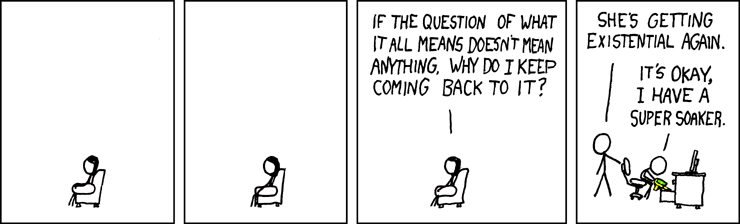 |
| http://xkcd.com/220/ |
I need to pray because it is the primary function I was made for. Or at least it is a reflection of the primary function I was made for. It is the closest I can get to the Garden of Eden. Prayer is me putting my hand against the prison glass while God holds his hand on the opposite side.
Then again, John Piper said, "Prayer is a wartime walkie talkie not a domestic intercom." That relates right? Yeah, it is true that prayer is our call for support and direction as we carry on the mission of serving God. I get that. But my first priority in prayer is not to call in a spiritual airstrike or even to find direction. My very first foundational task in prayer is to establish contact. Just to tune in and get a signal at all sometime seems like the biggest challenge. A lot of times the voice I hear when I pray most closely resembles my own. That doesn't mean that God isn't speaking to me, but it definitely makes it harder to listen.
It is easier not to pray. That is a lie that I often believe. It feels right in the moment. Distraction feels like a relief. A new distraction is like turning a corner when you're lost. There is no reason to believe that it will get you closer to your goal, but you get a feeling like it might lead somewhere important. All the while you've forgotten where you were trying to get to in the first place. Prayer means admitting that there is a real goal out there even if you are a little foggy about it at the moment. It is admitting that those distractions that are so enticing actually lead no where. Prayer introduces all the danger that an encounter with the Divine entails.
Danger! It is such a good word to go with prayer. You know that feeling when you approach the edge of a great height? When you are safely away from the edge, but walking closer gives you the feeling that you might be doing something foolish. At the same time it is exciting. The height itself takes on a personality. It draws you in. It promises you a scenic view that elicits a primal response that makes you feel alive.
Sometimes I don't think we like to feel alive. That's why distraction is so enticing. It helps us forget, not that we are going to die, but that we are alive at all. Distraction makes us feel like there is nothing at stake, like there is nothing to lose after all. Danger reminds us that loss is imminent. Prayer that doesn't feel dangerous is just more distraction. Today, I need to pray because I need to be dangerously close to God. Just stepping in his direction feels dangerous and that's good. Why do I need it?
Because I am franticly worried that I'm missing the most important part of who I am. That's why I signed up with Jesus in the first place. Yes, even when I was a child I new "something was missing." I didn't say it that way then, but I believed what my world presented me--that I was a sinner loved by God needing his mercy. I knew I needed something. My immature self was incomplete in a way that I felt would not be answered by learning more in school or asking more questions of my "why?"-weary parents. I can't explain it, but I knew. So I threw in my lot with the Lord. Since then I've made furtive advances. I shuffle my feet in the right direction, but I can rarely bring myself to look in the right direction for more than a moment. I'm stalling because I know the closer I get to the edge the more danger I'll see. For me prayer is like walking directly toward the edge of an unknown cliff. God is dangerous I know, but how dangerous? How ready am I to see him, really see him? I very well could be destroyed in the process. Oh, I know we deny that possibility by claiming the promises of salvation. But what is eternal life really? Will I be able to bear it? Is it survivable? Foolish questions I know, but I am a child. I ask childish questions.
I need to pray because when I've forgotten everything else and lost my direction I can see somewhere above me a single point of light. I can gaze at that light and somehow remember that I exist. I can follow the ray of that light down to my feet and see that I am indeed standing and can indeed move forward. Prayer is looking at the light and seeing what the light illuminates (hat tip to C.S. Lewis).
What am I doing? I'm praying. Yes. That's it. I need to be praying.
Monday, August 25, 2014
What is the Christian's Response to Violence?
The latest Israel-Palestine conflict is bringing an age-old question to a new generation of Christians. When you read much of the media coverage there is a big question that hangs over all of it especially for readers below the age of 50.
Why?
I don't mean to suggest that readers over 50 really know why the conflict is going on, but I do believe they've been through the same (or similar) cycle more than once during their adult life. My generation will most vividly think back to the "first" Iraq war, what we called the Persian Gulf War, and remember live CNN reports with journalists in gas masks in Israeli hotel rooms. We were all holding our breath to see if the Patriot missiles would out perform the SCUD missiles.
That actually had little to do with the Palestinian situation. It was merely Saddam Hussein's attempt to rally anti-Zionists to his side against Coalition forces. But it made us wonder about this whole Israel v. Middle East situation. Those of us in the Evangelical world felt sure it was closely related to the Bible and End Times. "Peace...in the Middle East" was a popular saying for politicians and rappers.
A generation later we have renewed violence between Israel and Palestine and the reaction is all over the map. Some cast the Palestinians as being oppressed and murdered by Israel. While others are rallying behind Israel as champions against terrorism. As I read the analysis I am struck by a philosophical assumption that goes so deep no one is bothering to defend it: death is bad.
But I wonder, why do they assume this? Stick with me a moment. It is a great human tradition that goes back as far as we can remember to assume that one's own death would be a bad thing. That makes perfect sense. It even makes since to feel like the death of your family, friends and business associates would be bad. What I don't quite logically follow is why secularists can assume other peoples' deaths are bad. Now I'm not attacking a secularists right to make moral assumptions. I just wonder if they understand that they are making an assumption that requires justification. Let me put it this way, if we are products of evolution, and if science is the ultimate arbiter of Truth, where does this universal (though selective when you consider the unborn) ethical preference for life come from? Secular society has been willing to question and abolish every other moral/ethical assumption. Why do we hold on to this one vestige primitive taboo and call it humanitarianism? Why does the mandate to save lives trump every other argument in any debate? Is there nothing more important than human life? If so, why are we so bad at protecting it?
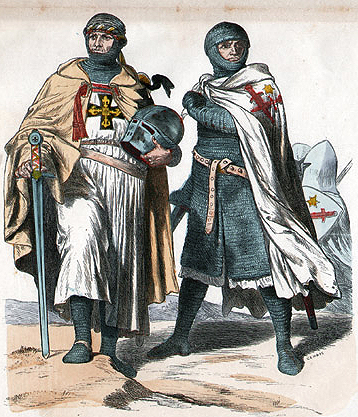
I honestly can't claim to understand the situation in Israel. When one tries to find the historical roots of the conflict one finds a tragic story of foreign powers making seemingly inconsequential decisions that end up affecting millions of people for generations to come. As far as I can tell, Jews, Christians, Muslims and others have all lived in the area for thousands of years. No one can claim exclusive ownership of the land based on history or heritage. It has been alternately conquered and and ignored for thousands of years. The Jews, at least, have a theological reason for wanting it, but who is to say that the State of Israel has any right to make a claim based on religion? The rule of Nature would say that whoever is powerful enough to own and posses the land will own and posses the land. The map as we know it was formed by violence at some point in our history. How do we (or how can we) differentiate between the violence of a thousand years ago, and 50 years ago, and 50 minutes ago? Was it justified then but not now? I don't think most people who have formed an opinion have thought through all those issues. I wish they would. I don't know that it would bring a quick solution, but at least they wouldn't sound so flippant in their affirmation of violence on either side.
For the Christian the question is simpler. We value life because God values life. He created people in his image. Therefore we are to respect life as an act of worship toward our Creator. Jesus has freed us from worry about where the "Promised Land" is. The Sabbath he has won for us is not a day of the week or a patch of land on this earth. The Sabbath rest Jesus leads us into--like Joshua led the Hebrews--is a never-ending land "flowing with milk and honey". It is not a day of the week because there will be no night. It is not a place under the Sun because there will be no sun. Jesus will be our source of light. We will not have to take up arms to conquer or defend it because He will put all his enemies under his feet. Forever.
I haven't answered questions about who we should support or how we should support them. Those are things I still struggle with. What I know above all else is that God is not pleased with the destruction of the people that he has created, and neither am I.
Why?
I don't mean to suggest that readers over 50 really know why the conflict is going on, but I do believe they've been through the same (or similar) cycle more than once during their adult life. My generation will most vividly think back to the "first" Iraq war, what we called the Persian Gulf War, and remember live CNN reports with journalists in gas masks in Israeli hotel rooms. We were all holding our breath to see if the Patriot missiles would out perform the SCUD missiles.
That actually had little to do with the Palestinian situation. It was merely Saddam Hussein's attempt to rally anti-Zionists to his side against Coalition forces. But it made us wonder about this whole Israel v. Middle East situation. Those of us in the Evangelical world felt sure it was closely related to the Bible and End Times. "Peace...in the Middle East" was a popular saying for politicians and rappers.
A generation later we have renewed violence between Israel and Palestine and the reaction is all over the map. Some cast the Palestinians as being oppressed and murdered by Israel. While others are rallying behind Israel as champions against terrorism. As I read the analysis I am struck by a philosophical assumption that goes so deep no one is bothering to defend it: death is bad.
But I wonder, why do they assume this? Stick with me a moment. It is a great human tradition that goes back as far as we can remember to assume that one's own death would be a bad thing. That makes perfect sense. It even makes since to feel like the death of your family, friends and business associates would be bad. What I don't quite logically follow is why secularists can assume other peoples' deaths are bad. Now I'm not attacking a secularists right to make moral assumptions. I just wonder if they understand that they are making an assumption that requires justification. Let me put it this way, if we are products of evolution, and if science is the ultimate arbiter of Truth, where does this universal (though selective when you consider the unborn) ethical preference for life come from? Secular society has been willing to question and abolish every other moral/ethical assumption. Why do we hold on to this one vestige primitive taboo and call it humanitarianism? Why does the mandate to save lives trump every other argument in any debate? Is there nothing more important than human life? If so, why are we so bad at protecting it?
I honestly can't claim to understand the situation in Israel. When one tries to find the historical roots of the conflict one finds a tragic story of foreign powers making seemingly inconsequential decisions that end up affecting millions of people for generations to come. As far as I can tell, Jews, Christians, Muslims and others have all lived in the area for thousands of years. No one can claim exclusive ownership of the land based on history or heritage. It has been alternately conquered and and ignored for thousands of years. The Jews, at least, have a theological reason for wanting it, but who is to say that the State of Israel has any right to make a claim based on religion? The rule of Nature would say that whoever is powerful enough to own and posses the land will own and posses the land. The map as we know it was formed by violence at some point in our history. How do we (or how can we) differentiate between the violence of a thousand years ago, and 50 years ago, and 50 minutes ago? Was it justified then but not now? I don't think most people who have formed an opinion have thought through all those issues. I wish they would. I don't know that it would bring a quick solution, but at least they wouldn't sound so flippant in their affirmation of violence on either side.
For the Christian the question is simpler. We value life because God values life. He created people in his image. Therefore we are to respect life as an act of worship toward our Creator. Jesus has freed us from worry about where the "Promised Land" is. The Sabbath he has won for us is not a day of the week or a patch of land on this earth. The Sabbath rest Jesus leads us into--like Joshua led the Hebrews--is a never-ending land "flowing with milk and honey". It is not a day of the week because there will be no night. It is not a place under the Sun because there will be no sun. Jesus will be our source of light. We will not have to take up arms to conquer or defend it because He will put all his enemies under his feet. Forever.
I haven't answered questions about who we should support or how we should support them. Those are things I still struggle with. What I know above all else is that God is not pleased with the destruction of the people that he has created, and neither am I.
ALS Ethical Dilemma

As has been pointed out by many this "dirt" came in the form of embryonic stem-cell research. Many sources started pointing out that the ALS Association does fund stem-cell research including one study that uses embryonic stem-cells.
There are mitigating factors to consider. Embryos used are those created as a byproduct of fertility efforts. When in-vitro fertilization is attempted there are usually unused fertilized eggs that parents can choose to donate to science. The research isn't creating embryos to experiment on. Still, does the source really matter? Also, it appears that the one embryonic study that is funded by ALSA is fully funded by one donor, meaning that currently none of the money that you give would be diverted directly to that study.
So what's the problem? ALSA could decide at any time to start funding embryonic stem-cell research.
What's wrong with that anyway? (This part is pretty involved. If you're just looking for alternatives to ALSA the skip to the end.)
Well, that depends on when you believe life begins. The Roman Catholic Church's as well as most pro-Life organizations' view is that life begins at conception, by which they mean at the moment of fertilization. Some even within the Pro-Life camp would clarify that they believe live begins at implantation. Further down the spectrum others believe in markers for life such as a heartbeat or brain activity. Finally, there are those who seem to believe that life doesn't begin until a child is born or maybe even several minutes after they are born.
If you are with the majority of Catholics and Evangelicals who believe life begins at conception then you also need to be against embryonic stem-cell research since that would be destroying living humans. You should also be opposed to in-vitro fertilization since that is what makes such research possible to begin with.
If you are with the segment that believes life begins at implantation or even at some point after, there is still an ethical question before you. Just because an embryo is not yet technically alive does that absolve us from any ethical responsibility to it? You see, the question isn't ultimately a scientific one, it is a philosophical/ethical one. Embryos are undeniably living (all of our cells are technically alive). The question is are they to be treated ethically as human beings. It seems clear to me that from the moment of implantation what you have is a viable human life that will, according to the rules of nature, progress if left unhindered into a fully formed self-actualized human being. The moments between fertilization and implantation may be a grey area, but what an important grey area! So important, I believe, that it is a far better moral option to avoid the grey area. By that I mean that it is better not to create fertilized eggs that will not have the chance of implantation. Creating embryos that will have no chance implanting and progressing to life is something that should be avoided wherever possible. This type of creation happens in nature (that is, embryos that are doomed to fail), but when we bend the course of nature to create them we become responsible for the outcome of this nascent human life.
So if you want absolutely no part of it, what are your options?
- If you've already given to ALSA, take comfort in the fact that it is very unlikely your funds will be used in this type of research.
- If you've yet to give but feel obliged to give to ALSA because of a promise or good faith statement or something, you can still do so. Simply stipulate that your funds must not be used for Embryonic Stem-Cell Research. (There are no common ethical objections to using adult stem-cells for research).
- If you haven't given yet, but you would still like to give toward ALS research, there are alternative charities.
- I personally would like to suggest St. Jude Children's hospital. They are not currently doing any embryonic research, and while they do not have a clear guideline that they will never do it, it seems they are on a course to avoid that kind of conflict all together.
- Team Gleason Is another suggested alternative that I haven't researched.
- John Paul II Medical Research Institute Is an organization that explicitly states they do not and will not support embryonic stem-cell research.
- The ERLC has more suggestions.
- Give to whoever you want! Honor the spirit of the challenge by keeping the movement going and supporting the cause of your choice.
Above all, avoid the temptation to become cynical. It is easy to find seedy human motives behind every activity we take part in. The challenge for those of us seeking Wisdom in this life, is to cling to that which is pure and holy wherever we may find it.
Philippians 4:8 Finally, brethren, whatever is true, whatever is honorable, whatever is right, whatever is pure, whatever is lovely, whatever is of good repute, if there is any excellence and if anything worthy of praise, dwell on these things. (NASB)
Subscribe to:
Posts (Atom)